27 May 2011

Blue Turning Gray

On our trailer-bike ride today my daughter sang me most of the songs on the soundtrack to the movie Tangled, as well as a few numbers from The Sound Of Music, too.  We also discussed many things as we rode along through the woods together, including whether or not angels have wings, and what the Earth was like before God did anything with it.

Perhaps most importantly, after she accidentally peed on her shoes while taking a break behind a tree, we had a long talk about how important it is to have a mountain-biker's attitude when you're out in the woods having fun.
"When things go wrong, what does a mountain biker do?"
"A mountain biker deals with it."
It's an important lesson, even if you've never peed on your shoes during a ride.  Another one of those great bike-makes-life lessons.


16 May 2011

Bike Parade

We rode our tandem-plus-trailer-bike over to Wildflower Bread Co. on Sunday morning for three oatmeals and a cheese danish to share. After breakfast, we rode downtown to ride in the annual Bike To Work Week Bike Parade. Such fun!

"Hey, a three-person bike!"
She got a temp-tattoo
There we go!

06 May 2011

Ghost Dancers

It's a tough time to be a public school teacher. Not as in end-of-the-school-year tough; the end of the school year is always tough, and comes as no surprise.

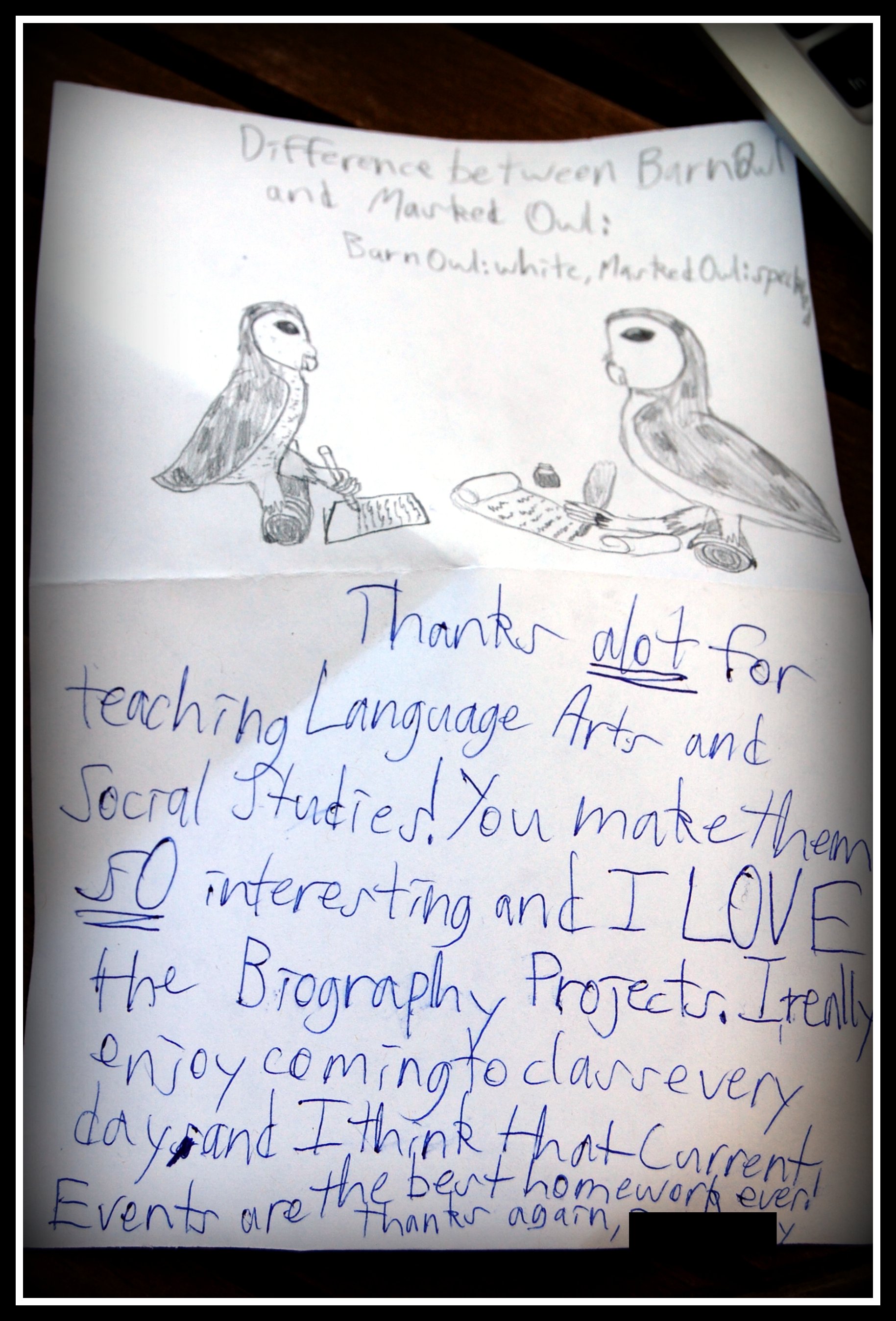
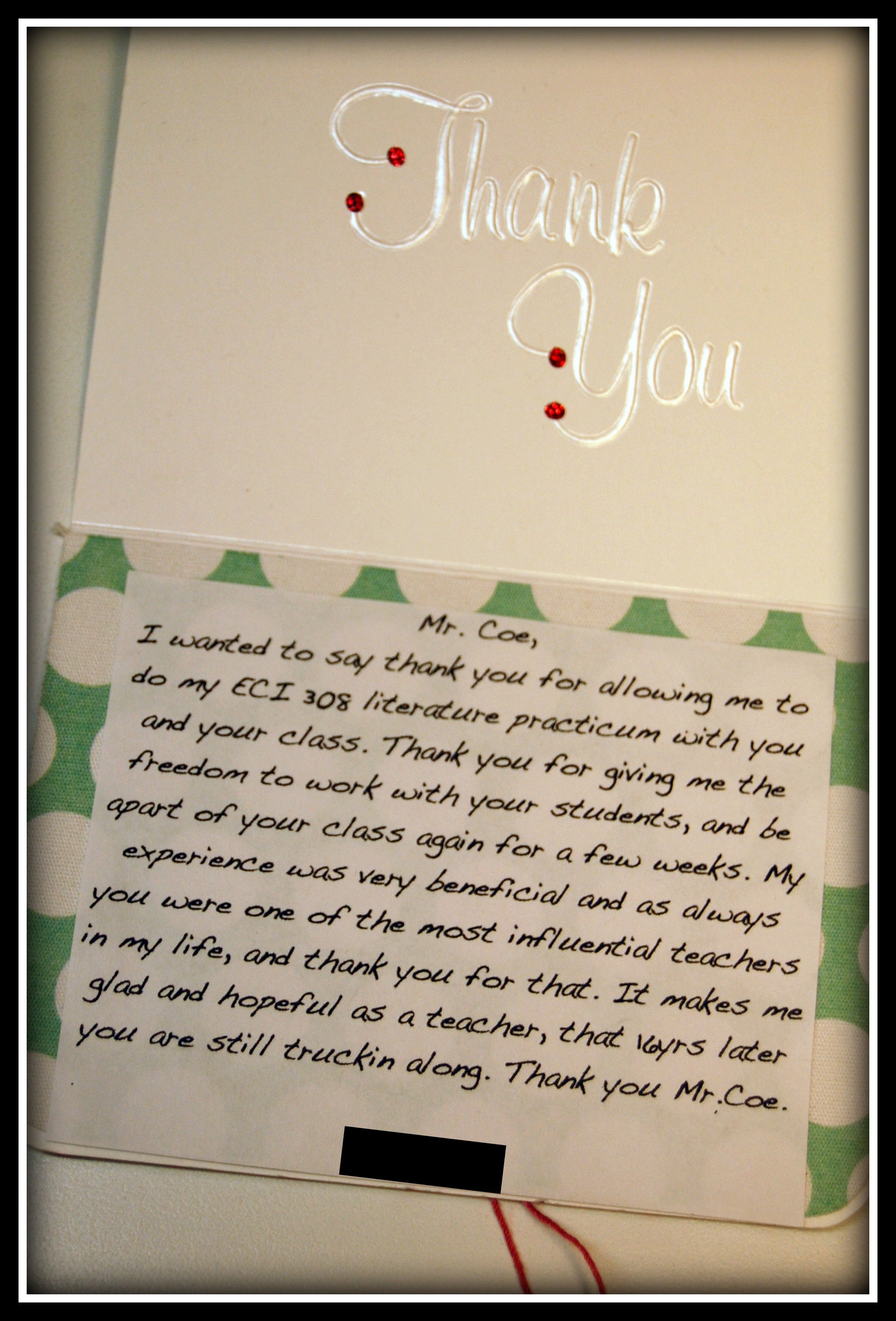
Received 5 May 2011
No, it's a tough time to be a public school teacher as in it's historically, a tough time to be a public school teacher. Sometimes it feels a bit like we're all just part of another big, hopeless Ghost Dance, albeit under somewhat less dire circumstances than the first Ghost Dancers faced.

There are lots of reasons for this, and I'm not going to go into them in any detail here and now. Which is probably a cop-out.  To be sure, Public Education needs a good apologist right about now. And I truly believe it's for-certain a system well-worth defending. But I don't think I'm called to be my profession's Great Defender. I'm really not equipped.

But, for whatever it's worth, I look around lately, in this small pool of educators with whom I swim, and a see a lot of beat-down, discouraged, bewildered teachers who never banked on any of this. I follow @DianeRavitch on Twitter and through her posts I read about similar sentiments all over the nation.  Universally, or so it would seem, public school teachers feel maligned and seem never to have imagined that they would ever feel the things, or hear the things, or be compelled to carry out or defend the things teachers seem to regularly face these days.

Fortunately, while being stripped of so much: a livable wage, our professional dignity, and the due-process assurances, benefits, and securities that previously made the job do-able, there is one thing that cannot be taken from us. Our legacy.

Received 26 April 2011
I've always loved being a teacher.  Well, almost always.  But the art-of-teaching, as I once knew it, is gone.  Five or ten years from now, perhaps even sooner, public education as we've all come to recognize it in this country really won't exist anymore.  There will still be public schools a decade from now.  But they will be very different sorts of places by then.  Almost unrecognizable.  That's what I think.

Nevertheless, regardless of what the future holds for our profession, for those who have spent the better part of half a lifetime teaching, as I pretty much have, there will always be one thing worth hanging on to: the knowledge that there are hundreds of former students out there who were once ours, and who perhaps still bear our imprint.

It's a prideful thing to recollect, this idea that you have taught several hundred students, and that you did your very best by each of them, and that some of them might remember you fondly from time to time.  But if it's prideful, so be it; these days, it's also a great thing to hang on to, too.

Because no one can ever take that away.

04 May 2011

"I love that!"

No need to drown this post in explication. The video fairly speaks for itself, I think.


What a great kid she is!

30 April 2011

Always almost falling down

Ever tried. Ever failed. No matter. Try Again. Fail again. Fail better.
Samuel Beckett

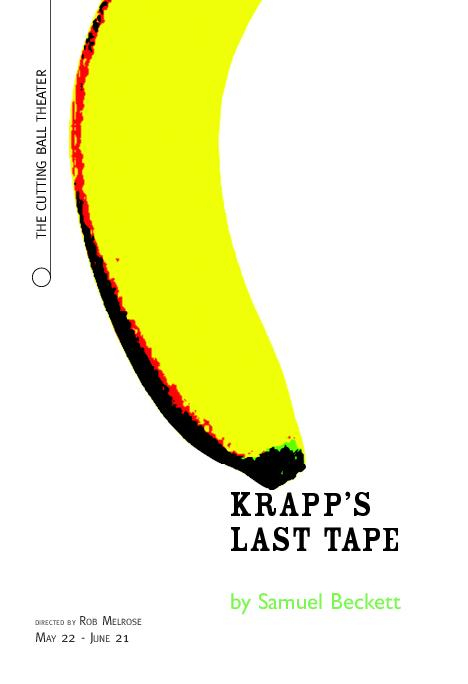
I once tried to adapt Samuel Beckett's play Krapp's Last Tape as a film script. It's an interesting work, an absurd, one-act, one-man show that Beckett wrote in the 1950s.  In the show, Krapp, the central-and-only character, is a desperately isolated individual who, nearing the end of his life, observes that it has been nothing more than a lengthy montage of failures, which he has collected as a kind of autobiography on a vast collection of audio tapes.

I wanted to update the concept a bit, expand the recorded vignettes we only hear in the play into something a bit more substantial, while bringing it into the then-20th century using video.  I was intrigued by the idea that, as a film, we could see as well as hear Krapp and his companions at the various points in his life Beckett has him recall in the play.  I know it's not what Beckett had in mind.  But I had this idea that it could be really cool.

At the time I was single, living alone.  Broken-hearted, even. A lot like Krapp.  So I got way into it.  Wrote madly for months. Thought I had something special in the works.  Even had a lot of fun reading and learning about film-script format and style, which was new to me. But, as the thing I was writing became more-real day-by-day, it occurred to me that I ought to formally seek approval from Beckett's estate for my adaptation.  So, after doing a little research, I contacted the agency-people who managed the rights to Beckett's works. And, I was told in no uncertain terms, "No. You may not adapt Krapp's Last Tape for film. None of Mr. Beckett's works are available for film adaptation."  Nevertheless, the executor was kind enough to suggest that I was free to use Beckett's work as inspiration, and even to treat my script as a kind of homage to his play.  He was, in fact, quite cordial with me.   But he was unwilling to compromise: as far as adapting it and using Beckett's title and content in my work, that was out of the question.

That rejection, sadly, took the wind out of my sails.  I never really went back to the script.  I moved on to something else. And so, Krapp's Last Tape: The Movie resides in a box under my bed.  A work unfinished.

A failure.


I was at a teacher conference in Scottsdale most of this week.  Teacher conferences are not my usual fare.  Over the years, I've been to several, but I would never describe myself as a conference-type.  Most of the time, I'd much rather be in my classroom, working with my kids, than somewhere else with a lot of adults talking about teacher-stuff.

Nevertheless, I was actually kind of flattered to be asked to attend this conference.  It was an important one, and it was expected that many important people would attend, and likewise that many important people would speak.

On the last day of the conference, one of the speakers, a British researcher named Dylan Wiliam, in his keynote speech on teacher learning communities, used the aforementioned Beckett quote on one of the slides in his presentation.
Ever tried. Ever failed. No matter. Try Again. Fail again. Fail better.
His point was: teacher improvement usually occurs along with failure.  And it is only through the recognition of that failure, and the ability to make corrections in response to that failure, that improvement begins.  An interesting idea: with training, time to practice, proper support, and the opportunity to reflect and move forward again, teaching can become more efficient.  Organically: fail; reflect; improve. And teachers will become better at teaching. That's what the man said.

But the quote, because it directly addressed the idea of failure, also got me to thinking about other things...

First: it reminded me about my failures as an adapter of the works of Samuel Beckett.

And, in the same moment, it got me thinking about another bit of research I'd read recently.  Not ed-research, but rather an interesting investigation that a few scientists from Cornell and elsewhere recently undertook to determine what makes a bicycle balance when you're riding it.  It may seem a ridiculous thing to study.  But it turns out, it's actually been a bit of a mystery for a very long time.  Truth is, until this research, no one really knew what it was that was making a moving bike stable. Hard to believe, isn't it.  There were lot's of assumptions: spinning wheels chief among them.  But there was very little data to support any of them.  Until now.  Here's a bit from their abstract:
[Bicycle] self-stability cannot be explained in any simple words. Bicycles are not stable because of gyros, because you can make a self stable bicycle without gyros. We did that. And they are not stable because of trail, you can take that away too. And we did that...

Why can a bicycle balance itself? One necessary condition for bicycle self stability is... a bicycle turns into a fall. 
This seven-minute video also explains their research.  I think it is fascinating and well worth watching.

In a nutshell: by removing the effects of the spinning wheels (gyros), and the angle and contact point of front wheel and fork assembly (trail), they were able to conclude one thing about bikes: a bike in motion balances because it is constantly falling over, and when it does the front of the bike is constantly being steered into the fall by the rear of the bike, thereby overcoming the potentially tragic effects of the fall.  Basically, bikes are always almost falling down.  But most of the time they don't.  Why?  Because the bike (and/or the rider) leans and steers to re-balance the bike, fixing and refixing the failure-to-balance, again and again and again.


As I write this, another in a series of broken ribs (four in the last 20 years) is nagging me, a reminder that I have not yet thoroughly perfected my riding technique; it would seem I am still able to override, through gross-motor error, my bike's natural tendency to want to right itself and not fall over.  Riding a bike is indeed a series of failures to which we adjust in order to avoid catastrophe. I am living proof.  Sometimes successfully even...

Teaching is likewise a series of failures to which we adjust in order to improve.  We know this.

Writing would seem the same.  Or so I might hope.

Ongoing failure may be inevitable.  But, cyclists, educators, and writers alike succeed when we turn towards the fall, not when we move away from it.  It stands to reason that it is Experience, in any pursuit, which makes us capable of making adjustments-to-avoid-failure by turning toward it in an ever-more intuitive manner.

Nevertheless, I think, there's got to be room to stand-back and contemplate, to visualize the process, and to make deliberate plans.  We can make this happen ourselves.  Or our leaders can recognize our need to do this and protect the time in which we need to do it.

But time is the key, I think.  No matter what sort of growth we're after, I think Time might hold the secret.

Time to do. Time to reflect. Time to improve.

Wash, rinse, and repeat.

23 April 2011

For your viewing pleasure

The first-annual Sedona Fat Tire Festival took place Saturday and Ken and I headed down early, hoping to have a look around and get in a bit of a shred, too. Before we got to the venue, we dropped some stuff off at Absolute Bikes in VOC and met up with our old-friend John, who lives in Phoenix now. John brought along his work-pal Ernie, too.

After picking up a couple demo bikes for John and Ernie at the Specialized booth we shuttled our three Epic 29ers (John got to ride the $10,000 carbon-fiber S-Works!) and one Stumpy FSR out to Dry Creek Road to hunt down a few trails, including a couple (Aerie and Rupp) that were brand-new to all of us.

Temps were cool all day under overcast skies, with a stiff breeze out of the southwest, and the trails were bone dry and often sandy, typical of the area this time of the year.  We rode a fun loop, a smidge over 11 miles (a middling-distance in Sedona-miles), full of fast singletrack, spring flowers, and wide vistas, from Lost Watch to Deadman's Pass, to Aerie, to Cockscomb, to Rupp, to Two Fences, and back to the van.

Nerd that I am, I brought along both my Garmin GPS and my handlebar-mounted 808 camera.  So, I've got both a map and a 3-minute video of our 3-hour ride to offer for your viewing pleasure.


Music: Red Dust by Calexico and Iron & Wine
View the flash version of the map here.

03 April 2011

You come too

I'm going out to clear the pasture spring;
I’ll only stop to rake the leaves away
(And wait to watch the water clear, I may):
I shan’t be gone long. You come too.
      --  Robert Frost

There are three ways to get home.

The Standard Way. The Fast Way. And The Long Cut.

In general, depending on the demands of my schedule, the weather, and sometimes the sort of bike I'm riding, I tend to pick from one of these options when heading home from work by bike.

The Standard Way
There's nothing wrong with The Standard Way.  It's just not especially interesting.  Like a cup of that what's-it-called Starbucks house-blend coffee, The Standard Way home is not especially memorable, but neither does it offend.  It is simply a well-balanced blend of bike paths, bridges, neighborhood side streets, urban trails, and short interstitial social tracks which cleverly connect here and there. The Standard Way is, in effect, just an afternoon rewind of my morning ride to work... a one-off sort of route that wouldn't make sense for anyone else unless you lived and worked precisely where I do, because it's really a point-A to point-B kind of thing.  Nevertheless, The Standard Way does take into consideration a few key factors, the most important of which is my desire to avoid car-traffic wherever and whenever possible.  This route does that well, making zero-use of main roads, major arterials, or congested signaled intersections.  The Standard Way might not be super-interesting, but it is definitely super-safe.

The Fast Way home is hardly worth discussing.  I take it when it's going to be dark soon and I've forgotten my lights.  Or when it's all snowy or rainy.  Or when it's midwinter and the trails are buried or caked in mud.  Or when I'm test-riding something unusual for a review, like a trailer or a set of skinny tires.  The Fast Way home is all roads, big cars, loud engines, exhaust fumes, and stress: red lights, stop signs, buses, crosswalks.  I hate it.  But it occasionally serves its purpose.  It's at least 50-percent faster than The Standard Way.  Fortunately, I am rarely in a hurry.

The Long Cut
Whenever my life's not in a hurry (and the woods aren't filled with snow), several days each week, I'm able to enjoy one of the great pleasures of my simple life, which is also one of the best fringe benefits of life here in Flagstaff: The Long Cut.  From a practical standpoint, The Long Cut makes no sense.  It's neither fast nor direct.  But what it does do well is wander.  And it is its glorious imprecision that I most love about The Long Cut.

The Long Cut buries the notion that a commute must be a means to an end and not an end in and of itself.  It defies the logic with which streets ever comply. It is non-linear, disordered, and unnecessarily difficult.  It is the perfect way to end any workday.  It's pretty much the way I've chosen to head home, whenever I've been able to, for the better part of the past two decades.  Because it is the best way home.

Scenes from The Long Cut
My Long Cut changed this year.  For the last 17 years or so, I rode home most days across the front side of Mount Elden along the Forces Of Nature trail system.  This year, The Long Cut takes me home via Rocky Ridge and the network of system and social trails that run along the base of Mount Elden.  Neither route is a huge ride, both are well under ten miles.  I've never taken great pains to prep for these rides; I've always just ridden home in my work clothes and riding shoes, on any one of the half-dozen different bikes that I ride regularly to work... cross bikes and mountain bikes, multi-speed, singlespeed, and fixed-gear bikes.  I carry a backpack that holds tools, tubes, and often my laptop, and sometimes I carry a partially filled Camelback holding about 20 ounces of water... though I occasionally forget to carry any water.  I try not to crash.  But sometimes I do.

Regardless, there are few things that I have found that are more centering, more cathartic, more empowering, more head-cleansing than an indirect ride home through the woods on your bike after work.  For me, it's almost always just what I need.
May your trails be crooked, winding, lonesome, dangerous, leading to the most amazing view. -- Ed Abbey

© John Taylor Coe
* ALL RIGHTS RESERVED *
2009-2026